project exposing school board members and school leaders focused on indoctrinating children rather than educating them.
Milwaukee Public Schools
The District celebrates “Pride Week of Action.” In 2025, they promoted a Pride Week of Action Toolkit and curriculum for each grade level.
- Pride Week of Action Toolkit (Sec 1, Sec 2, Sec 3):
- States: “Pride is rooted in resistance and resilience. It is a legacy of courage, joy, and community. As we celebrate, we also honor those who came before — especially queer and trans elders who fought to make spaces like ours possible.”
- The toolkit promotes LGBTQ books, movies and other resources for all ages.
- K-2 Pride week lessons: Teachers are instructed to read the book “Julian is a Mermaid,” about a boy who sees people dressed as mermaids on a subway. He begins to dream about being a mermaid. The book then discusses how he takes his clothes off and dresses himself like a mermaid using a curtain in his Nana’s house and putting on her make-up. Nana then gives Julian her pearls and takes him on an outing to be with other people (appears to be other people (including men) dressed like Mermaids.
- Teachers are then instructed to have students draw themselves and use decorations. They are told to ask students, “What’s something you learned about someone else today?” Teachers are also told to create vocabulary sheets based on the lesson.
- K-5 Pride week lessons: Instructs teachers to play a video for students called “My Shadow is Pink” about a little boy whose pink shadow comes alive and encourages him to wear a dress. Teachers are told to ask reflective questions and check students for understanding.
- 3-5 Pride week lessons: Teachers are instructed to read “The Boy in the Bindi,” while “pausing and asking understanding questions.”
- The book is about an Indian boy who is “gender non-conforming.”
- Teachers must also “introduce vocabulary terms for students with definitions and examples.”
- Teachers are instructed to have students “draw their visible identities” and on the other side draw “their invisible identities.” They are told to draw things that can be seen and “that cannot be seen.”
- Teachers are told to introduce historical figures like Harvey Milk.
- 6-8th grade has 2 different Pride week lessons:
- Exploring Intersectionality:
- “Students will understand the history of intersectionality and Jane Crow and how it has evolved to better understand LGBTQ+ identities.” Students are then put into groups to discuss their “intersectionality.”
- Students are also taught about “Black Feminism.”
- “Students will understand the history of LGBTQ+ peoples across different cultures and historical backgrounds.”
- Questions asked:
- How does what you have learned helped you to better understand gender and sexuality?
- In what ways can this history help society at large to rethink the ways we approach gender and sexuality?
- What do we gain by making this history more common knowledge?
- Students are instructed to learn, “terminology as it relates gender, sexuality, and other intersecting identities to better understand the LGBTQ+ community.”
- Students are given a wordbank activity to instruct them about people in history who identified as “intersex,” “two-spirited” and more.
- Teachers are instructed to “Give students 20 minutes to create their own society, with norms and expectations that center people from the LGBTQ+ community.”
- Questions asked:
- Students are also given something called a “Junk Journal” (sec 1 and sec 2) and instructed to document their thoughts. They are instructed to:
- “Create a visual representation of the joys of being queer.”
- Exploring Intersectionality:
- 9-12th grade Pride week lessons:
- “Students will be able to learn about Milwaukee queer history and its significance to the national LGBTQ+ movement.”
- Students must “understand Milwaukee queer history and how the 14th Amendment Equal Protection and Due Process Clauses grant same-sex marriage.”
- Students are instructed to watch a video about a black lesbian couple trying to get a marriage license.
- Part of the lesson on “Black Queer Trailblazers” requires students to complete activities that address issues such as “reproductive rights” and “reproductive justice.” Students are required to:
- “Your task will be to research the Black Lives Matter (BLM) Movement. At the end of the activity, you should understand how Black queer leaders play a significant role in the BLM Movement. Be prepared to discuss with the class a summary of the BLM Movement and information you learned about the Black queer leaders within the movement.”
The District has an “Equity Guidebook” that includes the following:
- Instructs on how to “isolate race” and “examine the presence and role of whiteness.”
- “Represent a diversity of perspectives and identities in authentic ways”
- “Address biases related to modes of expression and communication”
- Includes multiple links to the far-Left Southern Poverty Law Center (SPLC) resources on “bias.” The SPLC has been indicted on charges of paying extremists “engaged in the active promotion of racist groups.”
- Admits that “MPS will recruit, employ, support, and retain racially and linguistically diverse and culturally competent administrative, instruction, and support personnel.”
- “Desired Outcome: Attract, recruit, hire, nurture, and retain highly qualified individuals of color to educate students from pre-K through grade 12” (hiring based on race).
The District has had multiple years hosting a “Black Lives Matter Week of Action.” Most recently in Feb 2026 with the theme: “Globalism and Loving Engagement, bringing us together to remember we are part of a larger global family united in the ongoing struggle for education, justice, and liberation for all.”
The District has an entire department called the “Department of Gender & Identity Inclusion.” They provide resources to health clinics that provide “care for transgender patients, including hormone therapy.”
The District has a “Gender & Identity Inclusion” guidance document that states:
- “Individuals are allowed to have access to restrooms and locker rooms that correspond to their gender identity.”
- “All students are allowed to participate in physical education classes, clubs, and activities in a manner consistent with their gender identity.”
- “Individuals are allowed to participate in overnight trips and utilize facilities and accommodations that correspond with their gender identity.”
- “Individuals whose gender identity may not match what others perceive need staff and students to acknowledge and respect personal experiences and offer support for whatever level of transition they may choose to undergo.”
- “Each individual is different, and open conversation with trusted staff members is the best method for ensuring their needs are met.”
- “Staff who are approached by an individual who wishes to discuss their gender identity should provide a safe and confidential environment for the individual. Staff who are approached by a student and do not feel prepared or equipped to discuss topics of gender should continue to provide a safe and confidential environment for the individual. Additionally, they should connect the student to the appropriate support staff member, gender-inclusive support team, and so on. When in doubt, connect the student to your school leader or member of student services (school social worker, school psychologist, school counselor).”
- “In most cases, a staff member should share the information told in confidence by the individual only with staff members who are approved by the individual.” (no mention of parents).
- “If used, the Gender Support Plan (Appendix C) and/or Gender Communication Plan (Appendix D) should not be part of the student’s official record; a key person, identified by the student, should safely retain the plan in a separate file or folder. If the key person leaves the school, a member of the school support team should work with the student to identify a new key person.”
- KEEPING SECRETS FROM PARENTS — “Procedures for Staff to Guide Conversations with Students, Staff, and/or Parents/Guardians:
- K–5 students: Parents/guardians will most likely be involved and may initiate the conversation; however, staff must get permission from the student before communicating with parents/guardians.
- Grade 6–12 students: Get permission from the student before communicating with parents/guardians.
- The individual should choose who is involved in conversations about their transition. We understand the need to involve parents/guardians, and we want to ensure that we are not unintentionally causing harm given the sensitivity of the topic and needs of a person transitioning. Not all parents are supportive of their child’s gender identity; we want to avoid jeopardizing a student’s physical and mental safety.”
- “Guiding questions for this conversation should include the following:
- Is your parent/guardian aware of your gender identity?
- Is your parent/guardian aware of the name you want to be called?
- If your parent/guardian asks specific questions about your gender identity, how much information, if any, should I share?
- What name should be placed on your schoolwork, understanding that your parent/guardian may ask to view schoolwork during conferences or academic conversations?”
- “School personnel must be mindful not to reveal, imply, or refer to a student’s actual or perceived gender identity or gender expression when contacting parents/guardians when formal changes to official records have not been made.”
- “School personnel should be aware that involving parents/guardians without the permission of the student could lead to potential harm, such as being kicked out of their home or being disowned.”
- “Should a staff member or student continue to refuse to use an individual’s affirmed name and/or pronouns, corrective action may be taken and/or LGBTQ+ training may be suggested.”
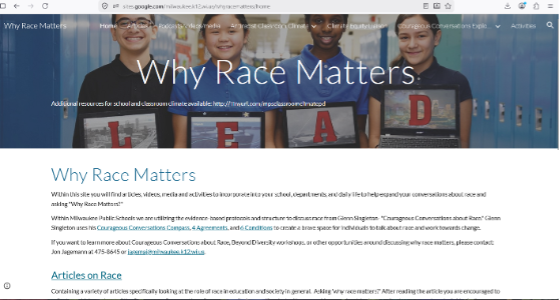
The District has a website called “Why Race Matters” that links to far-left resources.